venerdì 30 settembre 2011

Top 10 Pieces Of Fly Fishing Gear


Fly fishing is an interesting and varied sport with a seemingly endless array of gadgets and gear. The number of options can be confusing to someone new to the sport. What are the most important pieces of gear for fly fishing? The top 10 pieces of fly fishing gear include a fly fishing rod, reel, line, leader, flies, waders, net, vest, clippers and sunglasses.

The fly fishing rod is the first piece of must-have gear for fly fishing. Fly fishing rods are different from traditional fishing rods and are uniquely designed to allow casting of the fly line and fly. Most rods today are constructed from some type of graphite compound; however, some rods are still made from fiberglass or bamboo. Fly rods are categorized based on the weight of the line they are designed to be used with.

Fly fishing reels are actually less important than rods. Unlike traditional fishing, with fly fishing you do not reel the fish in. Fly fishing techniques involve stripping line with the free hand. Many fly fishing reels are actually quite primitive designs and therefore not all that expensive. Anglers frequently "palm" the reel to create drag rather than relying on internal drag mechanisms in the reel.

Fly fishing line is specially designed for this style of fishing. The line is considerably heavier than traditional fishing line and is frequently tapered and designed to float. Some line is designed to sink, however. Many anglers attach a backer line between the fly fishing line and the reel to increase the available line.

The leader is a clear, monofilament line that attaches to the end of the fly fishing line. The fly is tied onto the end of the leader. The leader is tapered down to a very narrow diameter at the forward end. The leader looks a lot like traditional fishing line.

Flies are available in a wide assortment of styles and designs. Dry flies are designed to float on top of the water, wet flies and nymphs are designed to be submerged, and other flies are designed to be partially submerged. Flies may also be categorized as imitative or attractive. Imitative flies are designed to imitate or look like a particular insect. Attractive flies are designed to attract the fist without looking like any particular natural food source.

Waders may be optional if you are fishing in warm water. However, many anglers fly fish in cold water streams and find waders absolutely essential. Popular wader styles today include neoprene waders and waders with a waterproof lining. Neoprene waders work well in cold water and serve to keep the angler warm. Waders with a waterproof lining are breathable and convenient when hiking alongside a stream.

A net is another essential piece of fly fishing equipment. Since fly fishing is usually done while standing in the water it can be very difficult to land a fish without a good net. Nets frequently have a hook attached so that the net can be hooked onto the anglers waders or vest. A net is also particularly important if the angler is practicing catch and release fishing.

Since fly fishing is usually done in the water a fishing vest is a near-essential piece of equipment. Vests allow you to keep essential tools and gear neat and handy for when you need it.

Clippers are very useful for clipping line when changing flies. You will rarely see a fly fisherman without clippers in their vest or pocket.

Sunglasses are one piece of personal gear you will not want to forget. Sunglasses keep the sun out of your eyes as well as protecting your eyes from stray fishing hooks. Good quality, polarized sunglasses will also help you see much better while out on the stream. Many anglers would also add a hat and sunscreen to the list of essential personal gear.

There are many more pieces of gear and gadgets that are available for the fly fisherman. These ten items are perhaps the most essential for a fun and successful outing though.

giovedì 29 settembre 2011

What Makes Fly Fishing Special


Fly fishing is a special approach to fishing. Fly fishing is different from bait-casting or spin-casting because fly fishing uses a weighted line to carry the nearly weightless bait forward when casting. Traditional fishing tackle is designed to have a nearly weightless line carried by weighted bait on the end. Because of this important difference fly fishing has its own gear, equipment and terminology.

Fly fishing also requires some different techniques than traditional fishing. Traditional fishing may involve casting a baited hook and waiting for a fish to bite or casting and retrieving a baited hook. However, fly fishing involves casting repeatedly with brief pauses to allow the fly to float in the current.

Fly fishing rods are different than traditional fishing rods in several ways. Fly fishing rods are longer than most fishing rods with their length frequently between six and nine feet. Some fly fishing rods are even longer than nine feet, particularly those rods designed for salmon or steelhead fishing.

Fly fishing reels vary from traditional fishing reels as well. Fly fishing actually does not require much use of the reel. Early fly fishing reels were little more than storage space for the line. Fish are not reeled in when caught; rather, the angler strips line with his or her free hand. Many fly reels still are very primitive with designs very similar to those used in the 19th century.

Fly fishing line is quite different from traditional fishing line. While traditional fishing line is made of a clear, monofilament material, fly fishing line is comparatively heavy and translucent. Fly fishing line may be designed to float or to sink depending on the style of fishing it is intended for; the line also may be tapered or level, again depending on the type of fishing that is planned and the preference of the angler. Fly fishing line is available in different weights. Heavier line can be cast further and has greater wind-resistance than lighter line. However, a lighter line may provide for more precise casting by an experienced angler. Fly fishing line is normally around 90 feet long but may be attached to a backer to lengthen the overall line available for fish that like to fight.

A leader is attached to the end of the fly fishing line. The fly is tied to the end of the leader. The leader is a clear, monofilament line normally between six and fifteen feet in length. The leader is tapered to a narrower diameter an the end of the line.

Fly fishing is also special because of the variety of fishing opportunities it provides. Fly fishing techniques can be used on streams, rivers, ponds and lakes. Fly fishing works in salt water and fresh water, cold water and warm water. Fly fishing can open up many opportunities to fish new waters because the techniques and equipment are so adaptable.

Fly fishing includes an interesting history that extends back at least to the second century. Macedonian fishermen successfully used artificial flies on six-foot poles to catch fish with. Fly fishing popularity increased in 19th century England and Scotland before catching on in the United States.

Fly fishing is a historically interesting, challenging approach to fishing. Fly fishing offers many opportunities and variations to anglers. Fly fishing also includes a nostalgic element that may not be found with other fishing styles.

mercoledì 21 settembre 2011

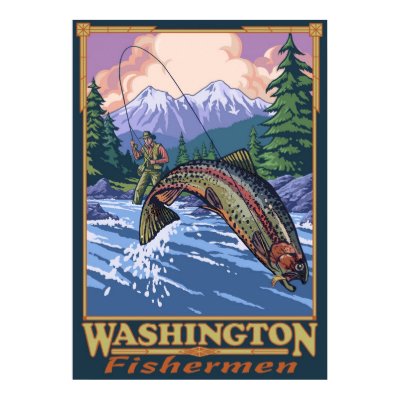
Washington Fly Fishing


It’s well known among many experienced fishermen that fly fishing in the great state of Washington can be a wonderful experience. The opportunities to catch a beautiful salmon or steelhead abound when you are casting your fly on the beautiful rivers, streams, and bays that dot Washington’s coastline.

Probably one of the most popular fly fishing destinations is the Yakima River. Nestled just outside the Cascade Mountains, the Yakima is well known for giving up some incredible fish. Because the weather in Washington can get quite cold in the winter months, the best fishing can usually be found in the spring and early fall. You’ll have an experience beyond your wildest dreams when you fish the Yakima.

Another great place for fly fishing in Washington is the Jurassic River located in the Northwest Corner of Washington. This river has incredible insect hatches that attract world class trout. The temperature on the river year round averages 48 – 65 degrees which makes for great fishing in any season. The best fishing, however is during low light in the summer months of June through August.

Described as a magical place for fly fishing, the Olympic Peninsula is a perennial favorite for a Washington fly fishing getaway. The forests and rivers in this place provide great scenery, and a wonderful adventure.

Deep dense forests, trees bearded with long strands of moss and ground covered with ferns add to the mysteriousness of this place. Strands of clouds hang in the creases of the forested mountains. Much of the time, it is so misty you can't even see the mountains. You will catch world class steelhead when fishing the Olympic Peninsula, so get ready for an amazing adventure!

There are many rivers on the Olympic Peninsula – many of which provide great fly fishing and record catches. The rivers are known for the trophy salmon and winter steelhead that they produce. The Quinault and Queets Rivers are home to some of the largest native Salmon and Steelhead ever landed. Prepare yourself for an angling experience to remember.

In addition to the native runs of trophy Salmon and Steelhead, the Quinault Indian Tribe operates three fish hatcheries producing thousands of returning hatchery fish each season. Opportunities abound for anglers in search of hatchery steelhead and salmon!

There’s no doubt that when you are planning to go fly fishing in Washington, you will have many great experiences ahead of you. Many of the rivers are catch and release waters, so you probably won’t be able to bring your prized fish home, but you will have the satisfaction of knowing that you were lucky enough to fly fish in some of the most beautiful waters in the Northwest United States.

martedì 20 settembre 2011

The History of Fly Fishing

The History of Fly Fishing

No one really knows when fly fishing first began. It is believed that it existed long ago in ancient times. One of the earliest written references to fly fishing was made by Claudius Aelianus. In 200 AD he wrote of people that were fishing in a river with a hand made fly. He described how they attached red wool and feathers to a hook. The rods they used and the sting attached were each about six feet long. These people were the ancient Macedonians. Throughout history from Aelianus to the present people have been writing about fly fishing, and many thousands of others have been enjoying the sport.

The Princess of Soapwell, English, was an avid fly fisherman. Her name was Dame Juliana Berners and she was a master at her sport. At the time Columbus was searching for the New World, Dame Juliana was publishing an extensive treatise on the art of fly fishing. In her treatise she described the twelve styles of fly and included extensive instructions on how to tie them. She patterns were put into categories by the month that they were used most often.

She also described the rod that was used for fly fishing during that time. It measured about 18 feet long and was very flexible, The rods were made of several different types of wood which added to their flexibility. Their lines were short, by today's standards, and were made of hand braided horse hair. The general rule of the time was that the line should not be longer then the fishing rod. The line was tied to the tip of the pole.

Many fly fishermen of today have used her patterns for the fly. They say they are just as effective today as they were more than five hundred years ago. Several of the more popular patterns include the Black Gnat, the Wooly Worm, the Stonefly and the Whirling Dun.

In the mid 1600's Isaak Walton published his book "Compleat Angler." Throughout history from then on, Izaak Walton has been considered the patron saint on angling, and of fly fishing in particular. In truth, it was actually his friend, Charles Cotton, that had contributed the portion of the book that pertained to fly fishing. The flies and rods described in this book were very similar to those described by Dame Juliana. However, the lines described were slightly different. They were still made of horsehair but were about six feet longer then those of the 1400's. The main difference was that some of the lines were tapered. It is believed that this was the first time tapered lines were described in writing.

In the early 1800's, fishing line makers began mixing silk in with the horsehair. By the time of the Civil War the first all silk lines were made. They were coated with an oily coating which made them water resistant. Horsehair lines were almost never used after that. Occasionally they were found in England up to World War II.

The first nylon line was made in 1948 and from that point forward synthetic materials have been used by most people for fly fishing. In 1952, a technology was created that made an automatically tapered line withe extreme precision.

domenica 18 settembre 2011

The Mysterious Allure of Fly Fishing


There is something about fly fishing that captures the hearts of many fishermen. To many people, the point of fishing is simply to catch a fish. However, this is not the case when it comes to fly fishing. Of course the fly fisherman wants to catch a fish. He actually devotes an extraordinary amount of energy, time and ingenuity to doing just that. But there is more to fly fishing than just catching a fish. He is interested in the activity itself. It is the act of fishing from which the fly fisherman derives so much pleasure, not just from the end result.

What is it about fly fishing that makes it so enticing? There is one main physical difference between other types of fishing and fly fishing. That difference may be the key to the enjoyment so many find in the sport of fly fishing. In all other forms of casting, the fisherman is throwing a weight on the end of his line, whether it is a lure or a sinker. Certainly, this does require a great amount of precision, but it is essentially like throwing a rock in the water. The fly fisherman, on the other hand, is casting only the weight of the line itself, which is spread out over 30 or 40 feet of line. The tiny fly at the end of the line is virtually weightless, and it provides no momentum at all. Fly fishing requires precision, delicacy, a gentle fine touch.

Many fly fishermen want to learn as much as they can about their sport, not just about fishing techniques. That includes the study of the insects that the fish feed on, studying the freshwater habitats, leaning about the history and lore of their sport, as well as the techniques of fly casting and fly tying. The fly fisherman has to be aware of everything from the cycles of the seasons to the life cycles of the insects. Fly fishing is not just another method of catching fish.

Fly fishing embraces the rhythm of nature as well as the rhythm of the rod. The rhythm of the rod carries your mind, body and spirit to the water. Whether you catch a fish are not, the water will always give you a little bit of its own, strength, some of its energy, and the wonderful feeling of peace.

The sport of fly fishing takes place in some of the most beautiful settings of the world including mountain streams, scenic lakes, the ocean's shorelines, and out on the high seas. Fly fishermen see and appreciate the wonders of nature. They care about the fish as well as the environment. Many of them take a proactive stance on environmental issues.

An anonymous fisherman once said fly fishing has a special hold on the spirit of man. This is because of all forms of fishing, it requires a perfect balance between discipline and freedom. Perhaps part if the mysterious allure of fly fishing is the feeling of harmony with nature and the gentle balance between man and fish.

Top US Fly Fishing Spots


Fly fishing is a sport that is enjoyed around the world. Millions of people have discovered the joy and excitement of fly fishing. While fly fishing is practiced in every state in the US some areas naturally rise to the top as offering the best fly fishing around.

The Catskill Mountains of New York are renowned for fly fishing. The late 19th century saw anglers in the Catskills developing artificial flies designed to imitate natural insects. The Beaverkill is perhaps the most popular of the Catskill rivers. The Willowemoc and the West Branch of the Delaware River are also very popular with fly fishers.

Jackson Hole, Wyoming and the surrounding area offers near-unlimited fly fishing options. The Snake River and Jackson Lake are popular fishing choices outside of Jackson Hole. Jackson Hole is accessible by ground or by air to the Jackson Hole airport. Jackson Hole provides more fly fishing options within a few miles than any angler could explore in one visit.

Henry's Fork of the Snake River offers legendary rainbow trout fishing. This area, particularly around Harriman State Park (Harriman Ranch) is legendary for its fly fishing. The area is open and offers unobstructed fishing. Downstream from Harriman Ranch the fishing is reputed to be faster paced.

The San Juan River in New Mexico affords excellent year-round fishing. The 10-mile stretch of river below the Navajo Dam boasts 10,000 fish per mile of river. The section below the dam is populated mostly by rainbow trout with brown trout and cutthroat trout found further along the San Juan.

Gallatin River around Bozeman, Montana is renowned for rainbow trout. Nearby, just south of Livingston, creeks have up to five insect hatches each day. DePuy's, Nelson's and Armstrong's all have fantastic rainbow trout fishing. Armstrong's Spring Creek is a meadow stream from 50 - 100 feet wide and known for its rainbow trout. Spectacular mountain scenery rounds out the fly fishing experience here.

The Wind River Range in Wyoming has an estimated 700 trout lakes. These lakes include cutthroat, brook, rainbow, grayling, brown and golden trout. This range is primarily high country and offers great hiking as well as fly fishing.

Michigan's Au Sable River offers 180 miles of trout fishing. Located in northeast Michigan, the Au Sable River is home to rainbow, brook and brown trout, as well as steelhead from Lake Huron. The Au Sable offers a variety of fishing conditions along its distance.

The Jacks River in Georgia is a Conasuaga River tributary. The Jacks River is largely in the Chattahoochee National Forest and therefore is accessible to the public. The Jacks River provides fly fishing opportunities for rainbow, brown and brook trout. The area is popular with hikers but sees fairly light fishing activity.

Northeastern Utah's Green River offers extraordinary trout fly fishing. The tailwaters below the Flaming Gorge Dam offer outstanding trout habitat. It was this 30-mile section of river that produced a 30 pound brown trout only 10 years ago. Unfortunately, this secret is out and summer finds the river quite busy. Early spring and fall offer less competition and a very large number of trout.

The United States boasts some great fly fishing waters. There area even more opportunities if you venture north into Alaska or Canada. As this list shows though, there are many great fly fishing opportunities right here in the United States.

mercoledì 14 settembre 2011

History Of Fly Fishing

History Of Fly Fishing

Fly fishing has been around in various forms for many years. Early historical records indicate that Macedonian fishermen were using artificial flies to catch fish as early as the second century. The Roman Claudius Aelianus described the Macedonian anglers as using six-foot rods with six-foot line. Aelianus detailed how the Macedonian fishermen would craft artificial flies from a hook with red wool and insect wings tied on. These Macedonian fishermen were apparently quite successful with their technique. There is also some evidence that fishing with artificial flies may even predate the second-century Macedonian techniques.

Unfortunately, little else was written about ancient fly fishing methods. It was 1496 before any major work was published describing fly fishing.

It is thought that modern fly fishing probably developed in England and Scotland. Fly fishing techniques similar to modern techniques began to be developed in England in the 19th century. Around this time fly fishing clubs were also formed in England to accommodate a growing interest in the sport. Part of the interest in fly fishing in southern England was because of the prevalence of shallow, weedy rivers. Fly fishing proved to be well-adapted to this type of water course.

Fly fishing quickly became something of an elitist sport in England. Fly fishing purists insisted on fishing with dry flies only and looked down on wet fly fishing as being inferior. Wet fly fishing continued to be developed around the same time, however. The US and Scandinavia also saw fly fishing popularity increase during the 19th century. However, anglers in the US and Scandinavia did not share the English view concerning the superiority of dry fly fishing. US and Scandinavian anglers fished both dry and wet flies.

Fly fishing materials have continued to develop over the years. Significant advances have been made in fly fishing equipment, including rods, line and flies.

Early fly fishing rods were made from a tropical wood known as greenheart. Bamboo replaced greenheart as fly fishing popularity spread. Bamboo rods were further refined as American rod builders developed advanced rod building techniques that involved cutting the bamboo into strips before gluing the bamboo back together around a solid core. Following World War II fiberglass became a popular material for fly rod construction. The fiberglass rods were more affordable than their bamboo predecessors since bamboo rods may take as much as 100 hours to build. Modern fly fishing rods are usually made from a graphite compound. Modern rods are less expensive than earlier rods and perform exceptionally well.

Artificial flies were originally made from natural materials like feathers and fur. Most modern flies are made from synthetic materials.

Fly line has also been improved quite a bit. Fly fishing line used to be made of horse hair. Horse hair line was replaced by silk line. The silk line was an improvement over horse hair but the line still had to be removed from the reel periodically to allow it to dry.

US interest in fly fishing peaked in the 1920s with Maine, Vermont and Wisconsin being the most popular areas for fly fishing. Interest increased again in the 1950s with the development of affordable, fiberglass fly fishing rods, synthetic fly line and monofilament leaders. These developments served to make fly fishing a more affordable sport for many people.

domenica 11 settembre 2011

California Fly Fishing

California Fly Fishing

There’s no doubt about it that some of the best fly fishing in California is located in the northern part of the state. The Sierra Mountains provide some great scenery as well as some great rivers and streams where the fish are plentiful and the weather is great. Because the California weather is quite static, year-round fly fishing is available to the fisherman.

Located above Crowley Lake, the Owens River is one of the best places to fish for trout in California. The river is one of a kind with a gentle current that flows through a glacial valley between mountains that are 9,000 feet tall or more. At one time, the Owens River provided water and power to Los Angeles. When they converted the gorge, much of the fish died out. With a restoration of the river back to a fly fishing destination, you can now find some beautiful brown or rainbow trout at any time of the year.

The McCloud River is one of California’s premier trout fisheries. This River feeds Lake Shasta and was the breeding ground for rainbow trout that was shipped all over the country to stock other rivers and streams. You can find big brown trout as well as rainbow trout in plentiful supply on the McCloud.

In Northern California, the Middle Fork of the San Joaquin River provides some great fly fishing for some excellent trout. This river is one of the few places designated as wild trout waters by the state. This area receives a lot of fishing, so it’s a good idea to get there early in the morning to stake out your spot. Besides the normal species of trout, this river also boasts a hybrid variety of rainbow and golden trout with bright orange sides.

Hat Creek is another great place to fly fish in California. These, too, have been designated trophy wild trout waters, and you will find plenty here. This creek is very well-suited to both beginning as well as experienced fly fishers. The banks are laden with heavy brush that provides some great hiding places for brown and rainbow trout. Much of the creek is heavily stocked, but there is some natural reproduction that takes place making Hat Creek a very easy place to fish.

If you are looking to go fly fishing in California, you have a lot of options available to you. Much of the best fly fishing would be in the northern part of the state, but you can also find many other places where fish are plentiful and challenges about. You can’t go wrong with a fly fishing vacation in California.

venerdì 9 settembre 2011

Fly Tying Tips and Tools

Fly Tying Tips and Tools

Tying your own flies can be very rewarding and relaxing. It also has another benefit in giving you something to do if you are unfortunate to live where the rivers are frozen in winter, or fly fishing is closed for some months each year.

The tools are simple. You could make most of them yourself, however it would be best for beginners to buy at least a fly tying vice. There have been over the years quite a number of different vice types manufacturered. In my opinion, the cam type of vice is the easiest to use. This is a vice that has a cam lever to open and close the jaws. It's adjustable to various angles and hook sizes. Quick and easy to open and close.

The next thing to get your hands on are some hackle pliers. These are also a cheap spend, but really worthwhile. They are a little difficult to make a pair yourself.

Apart from these items, you'll need a pair of curved scissors with sharp points and another set with small straight blades. You probably could also do with a needle that is pushed into a stick. This is for fixing hakkles that have been inadvertantly wound under. You can also use it for putting laquer onto the finished head.

What sort of hooks should you use? My advice is to not fall for the trap of using any old hook. Buy proper fly hooks. These have a tapered shank and are usually hollow ground. These are lighter than normal hooks, a real advantage in dry flies.

The tapered shank lets the head, especially the eye of the fly be tied tighter and smaller. When you consider the work involved in tying a fly, why waste effort on the wrong hook. If you make a mistake, all you need to do is cut the fly off the hook and start again.

Something you could consider these days is the opportunity of actually buying a complete fly tying set. These sets cost only around $50 or so. They have vices, scissors, pliers, hooks and all the feathers and fur you need to get started. Some even come with videos or DVD's.

Whichever way you go, it is a cheap way to spend many an hour, in preparation of catching your next bag of fish. The satisfaction of catching your next trout on a fly you tied yourself is imeasureable.

sabato 3 settembre 2011

Northern California Fly Fishing

Northern California Fly Fishing

One of the best things about California is the nice weather. For people who love to fly fish, Northern California is a paradise on the West Coast. Many streams in Northern California stay open year-round offering great options for fishing trips. There are some great options for the avid fly fisher when in Northern California.

The lower part of the Sacramento River is a prime place to catch California’s largest rainbow trout. The river provides amazing year-round fishing opportunities. You can catch some amazing fish in both winter and spring, but spring brings a huge caddis fly hatch that brings the fish out in droves. You can also find some great salmon catches on the river – especially in the fall and winter.

Feather River is a great place to catch steelheads. Fishing on this river is exciting, productive, and challenging all at the same time. The best fishing is in the fall where adult steelheads weighing over four pounds can be found quite easily. In the spring, you will also find some great opportunities to fly fish for some record catches.

If you’re looking for a challenging fly fishing experience in Northern California, you may want to look at the East Fork of the Carson River. This stream provides trout anglers with many different experiences - access being one. The narrow, fast-flowing upper reaches, above Wolf Creek, are accessible only by a rough four wheel drive trail, on horseback, or by foot.

This is a classic freestone stream with lots of riffles, rapids, deep runs, and pools. These conditions create excellent habitat for stoneflies, caddis flies, and some species of mayflies throughout the Carson drainage. Large fish are consistent on the Carson, especially around the Nevada border where the river branches off providing a great place to find the fish.

The Truckee River is the largest of three major river systems in the Northern California/Reno area. The good weather provides year-round fly fishing with easy access, beautiful canyon scenery, and feisty wild trout. Experts rate the Truckee as one of the best fly fishing rivers in Northern California. It is, however, a tough river to fish because of the current where it flows into the Nevada area.

These are only a few of the myriad of choices you have available to you for fly fishing in Northern California. You have a lot of options to catch some amazing fish plus, you can enjoy fly fishing year-round in the balmy Northern California weather. It can be a great opportunity for you to hone your fly fishing skills and plan a wonderful fly fishing getaway.

venerdì 2 settembre 2011

Salt Water Fly Fishing

Salt Water Fly Fishing

Salt water fly fishing has grown in popularity over the past half century as many fisherman experience the thrill and excitement of the sport. Some choose to don their waders and fish from the shoreline, some prefer to use a small boat as they explore shallow fishing areas, and still others opt for the adventure of deep sea fly fishing. Nearly three quarters of the earth is covered with salt water, giving those who enjoy salt water fly fishing an unlimited number of places to fish.

Understanding the flow of the tides is essential for any salt water fly fisherman. Tides affect the water's temperature and its clarity two of the factors that have an effect on the movement of the fish in the area. If you are fly fishing near an inland bay or a lagoon, the tides will play a major role in choosing the best area f to fish. For example, if the body of water is tide-drained through a narrow creek, fish will be feeding on the smaller fish that have been swept through it. The best place to fish is down side of the mouth of the creek.

On both the Atlantic and Pacific coats the tide rises and falls twice within a twenty-four-hour period. In the Gulf of Mexico, there are some places where the tide rises only once a day. There are thousands of miles of coastline in the United States which offer an almost unlimited number of locations for fly fishing.

Most salt water fly fishing is done in relatively shallow waters, or very close to the shore. This is called inshore fishing, and includes fly fishing done from the shore or from a small boat in shallow waters. Many varieties of fish can be taken while inshore fishing including striped bass, channel bass, bluefish, bonefish, flounder, bonito, barracuda, rockfish, cobia, halibut, jack crevalle, jewfish, ladyfish, mackerel, pollack, pompano, shark, snapper, snook, rooster fish, tarpon, and weakfish.

Deep water fly fishing can be extremely exciting and challenging to a salt water fly fisherman. This type of fishing is done in water more than twelve feet deep from a boat that can range in size from a ten foot skiff to a 50 foot oceangoing vessel. Deep water fly fishing is quickly becoming one of the most popular ways to fish.

Deep water fish sought by fly fishermen are roughly divided into to categories, roamers and homebodies. Roamers are mostly pelagic and move great distances in a short time. Some of the varieties of roamers that can be caught while fly fishing include albacore, dolphin, marlin, wahoo, sailfish, yellowtail, and tuna. Homebodies sometimes appear in schools, but it is not unusual to find a solitary one. Homebodies include African pompano, Great barracuda, rockfish, grouper, amerjack, and snapper. These are only a few of the many vanities that are available to fly fishermen that fish the deep ocean waters.

Whether you decide to fish inshore or deep sea, slat water fly fishing will provide an exciting, challenging and memorable experience.